


Latex vs Nitrile Finger Cots: Which One Is the Right Choice for Your Industry?
Selecting the right finger cot is more than simply choosing between two materials. The wrong choice can increase contamination risks, reduce operator comfort, shorten product lifespan, and ultimately raise manufacturing costs.
Latex and nitrile are the two most commonly used materials for finger cots. Each offers unique advantages depending on your production environment, industry requirements, and application.
So, which one is the better choice?
The answer depends on your production needs. This guide from Komex Vina compares latex and nitrile finger cots to help you make an informed decision.
Understanding Latex Finger Cots
Latex finger cots are made from natural rubber and have long been the preferred choice for precision assembly due to their excellent elasticity and tactile sensitivity.
Their soft, flexible material allows operators to handle delicate components with greater control, making them particularly suitable for industries where precision is essential.
Advantages of Latex Finger Cots
✔ Excellent elasticity for a comfortable fit
✔ Superior tactile sensitivity
✔ Excellent grip for handling small components
✔ Cost-effective for large-scale production
✔ Environmentally friendly natural rubber material
Because of these characteristics, latex finger cots remain the preferred option for many electronics manufacturers.
Limitations
Despite their advantages, latex finger cots are not suitable for every application.
Potential limitations include:
- Natural latex may cause allergic reactions in sensitive users.
- Lower resistance to certain chemicals and solvents.
- Not ideal for applications involving aggressive chemicals.
Understanding Nitrile Finger Cots
Nitrile finger cots are manufactured from synthetic rubber and are becoming increasingly popular in industries where cleanliness and chemical resistance are priorities.
Unlike natural latex, nitrile contains no natural rubber proteins, making it an excellent alternative for users with latex allergies.
Advantages of Nitrile Finger Cots
✔ Latex-free material
✔ Excellent chemical resistance
✔ Better resistance to oils and solvents
✔ Low particle generation
✔ Suitable for cleanroom environments
Nitrile finger cots are widely used in pharmaceutical production, laboratories, medical device manufacturing, and cleanroom operations.
Limitations
Compared with latex, nitrile finger cots generally:
- Cost more.
- Offer slightly lower elasticity.
- Provide slightly less tactile sensitivity.
However, these trade-offs are often worthwhile when contamination control is the highest priority.
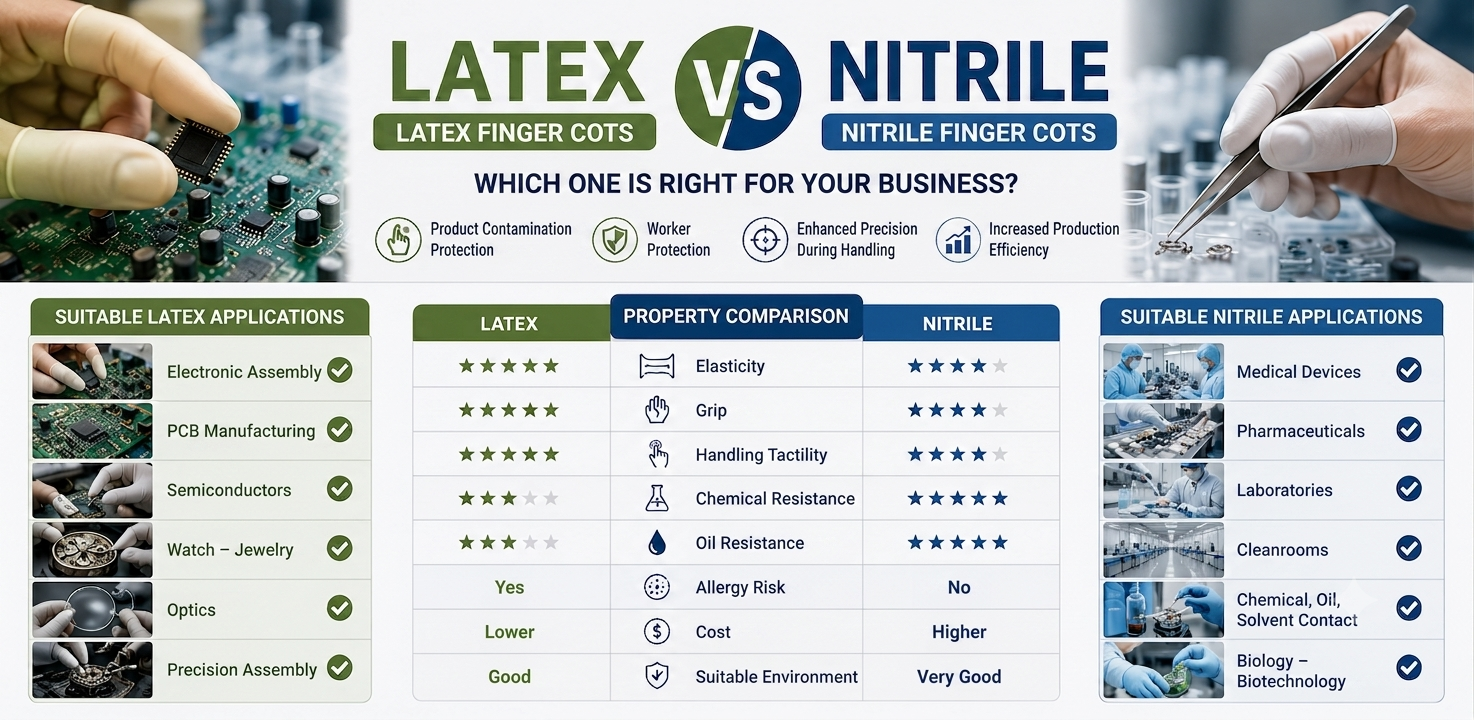
Latex vs Nitrile Finger Cots: Side-by-Side Comparison
| Feature | Latex | Nitrile |
|---|---|---|
| Elasticity | ⭐⭐⭐⭐⭐ | ⭐⭐⭐⭐☆ |
| Tactile Sensitivity | ⭐⭐⭐⭐⭐ | ⭐⭐⭐⭐☆ |
| Grip | ⭐⭐⭐⭐⭐ | ⭐⭐⭐⭐☆ |
| Chemical Resistance | ⭐⭐⭐☆☆ | ⭐⭐⭐⭐⭐ |
| Latex Allergy Risk | Yes | No |
| Oil Resistance | Fair | Excellent |
| Comfort | Excellent | Very Good |
| Cost | Lower | Higher |
| Cleanroom Suitability | Good | Excellent |
Which Industries Prefer Latex Finger Cots?
Latex finger cots are ideal for applications requiring exceptional dexterity and precise handling.
Typical industries include:
- Electronics assembly
- PCB manufacturing
- Semiconductor packaging
- Optical lens production
- Watch manufacturing
- Jewelry assembly
- Precision engineering
In these environments, excellent grip and tactile sensitivity help operators improve productivity while minimizing handling errors.
Which Industries Prefer Nitrile Finger Cots?
Nitrile finger cots are preferred in environments where cleanliness and chemical resistance are essential.
Common applications include:
- Medical device manufacturing
- Pharmaceutical production
- Biotechnology laboratories
- Cleanroom operations
- Chemical handling
- Research laboratories
Their latex-free composition also makes them suitable for workplaces with strict allergy prevention policies.
How to Choose the Right Finger Cot
Instead of asking, “Which material is better?”, ask:
Which material is better for my production process?
Choose Latex Finger Cots if you need:
- Maximum flexibility
- Better grip
- Excellent tactile sensitivity
- Lower purchasing cost
- High-speed precision assembly
Choose Nitrile Finger Cots if you need:
- Latex-free products
- Better chemical resistance
- Cleanroom compatibility
- Oil resistance
- Reduced allergy risks
The right material depends on your manufacturing environment, quality standards, and production goals.
Why Choosing the Right Manufacturer Matters
Even the best material cannot compensate for inconsistent manufacturing quality.
When selecting a supplier, consider:
- Stable product quality
- Uniform thickness
- Consistent sizing
- Strict quality inspection
- Reliable packaging
- OEM capability
- Export experience
Working with an experienced manufacturer ensures consistent performance across every production batch and helps reduce long-term operating costs.
Looking for the Right Finger Cot Solution?
Whether you choose latex or nitrile, selecting the right product can improve productivity, reduce contamination, and enhance product quality.
Komex Vina manufactures a complete range of latex and nitrile finger cots for electronics, semiconductor, medical, laboratory, cleanroom, and industrial applications.
We provide:
✔ More than 30 years of manufacturing experience
✔ OEM & Private Label services
✔ Consistent quality control
✔ Flexible production capacity
✔ Export support for customers worldwide
Contact Komex Vina today to request samples or receive professional recommendations for your application.